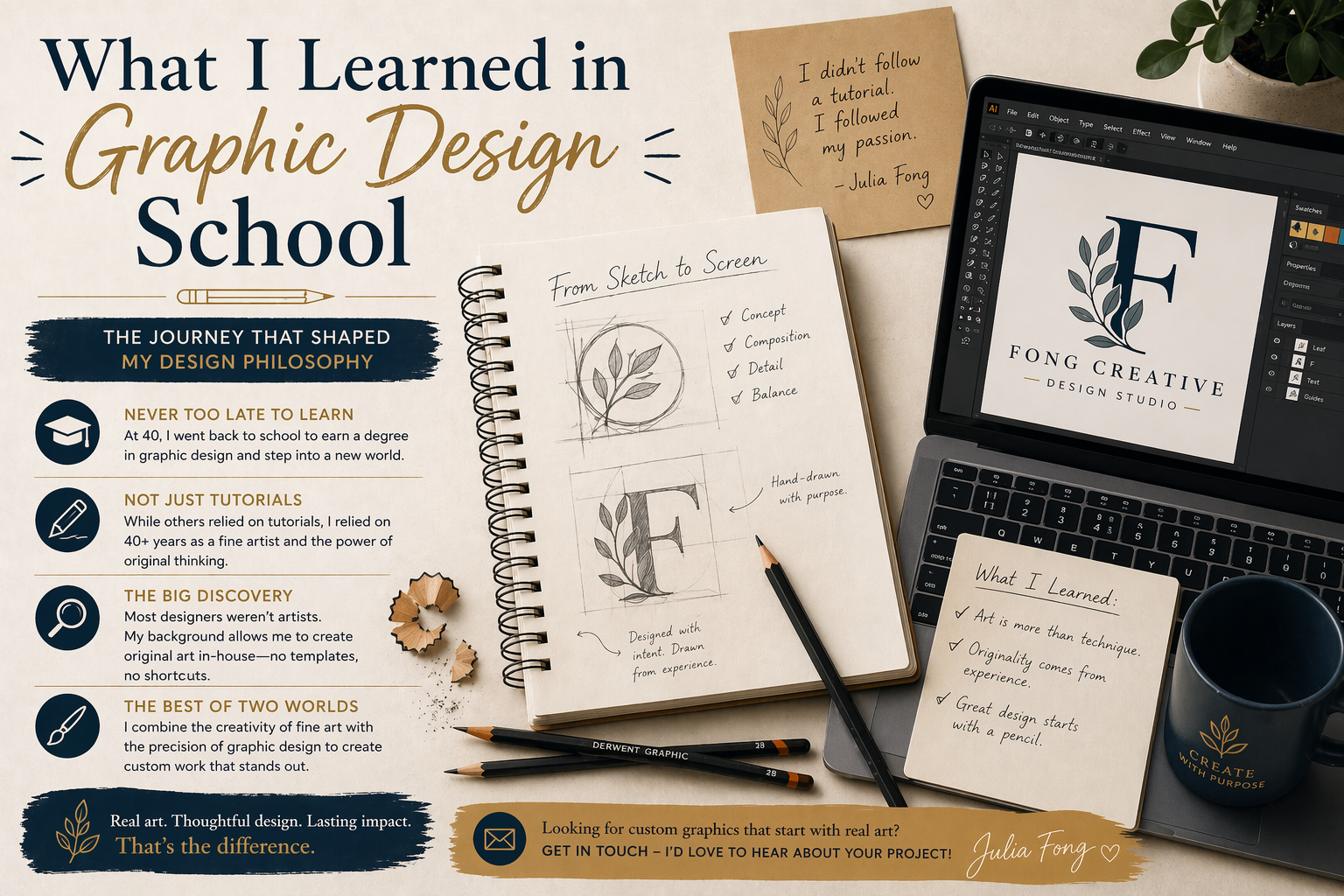
What Graphic Design School Taught Me About Originality
I have been drawing for as long as I can remember.
Long before computers, before design software, before digital tools—there was always a pencil, paper, and an idea.
Art was never something I had to learn.
It was something I always did.
Going Back to School at 40
At age 40, I decided to go back to school and pursue a degree in graphic design.
Not because I didn’t know how to create—but because I wanted to understand the digital side of design at a deeper level.
I already had a business background, and I believed in continuing to grow.
So I went all in.
“What Tutorial Did You Use?”
One moment from school has stayed with me ever since.
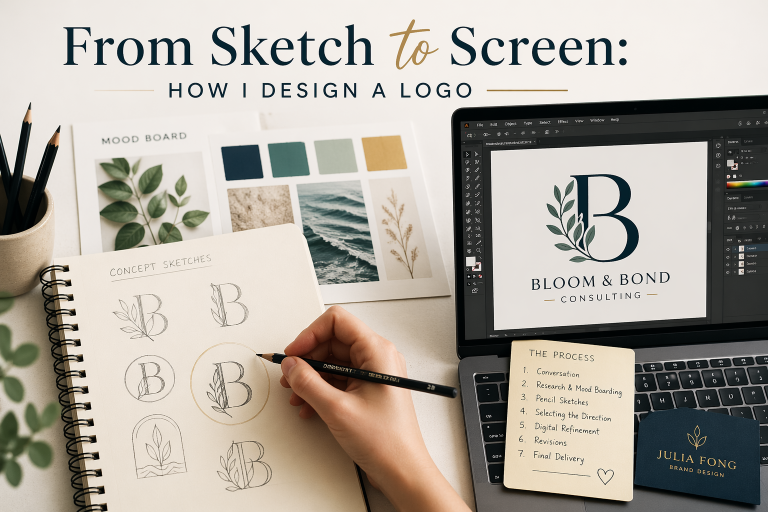
During a class project, I created a design by hand—starting with a pencil sketch and then translating it into a digital piece.
A younger student leaned over and asked me:
“What tutorial did you use?”
I paused.
“What do you mean?” I asked.
She said, “Yeah, what tutorial showed you how to come up with that design?”
That was the moment everything clicked.
Many designers weren’t creating—they were following steps.
The Difference Between Tools and Thinking
There’s nothing wrong with learning tools.
But tools are not the same as creativity.
Software can help you execute an idea.
It cannot create one for you.
That’s where many businesses run into problems.
The design may look polished…
But it feels generic.
Because it was built from steps—not from understanding.
What I Discovered After Graduation
After finishing school, I started researching other designers—calling around, asking questions, and learning how different people approached their work.
What I found was eye-opening.
Many designers relied heavily on templates, pre-made assets, or outsourced illustration work.
That doesn’t make them bad designers.
But it does explain why so much design starts to feel the same.
And when everything feels the same, nothing stands out.
Why This Matters for Your Business
Your customers may not be able to explain why something feels “off.”
But they feel it.
When your visuals are:
- too similar to others
- lacking originality
- or not aligned with your level of service
It creates a subtle hesitation.
And hesitation reduces trust.
That’s the real cost of generic design.
The Best of Both Worlds
Today, my process combines both sides:
- fine art fundamentals (drawing, composition, color, storytelling)
- digital tools (precision, scalability, production-ready files)
Every project starts with a sketch—then becomes a refined, professional design.
Not built from templates, but built with intention.
What to Do Next
If you’re wondering whether your current branding feels original—or just blends in—start here:
👉 Download the free guide: What Your Business Is Really Communicating
It will help you quickly see how your business is coming across to customers.
If You Want a Clear Answer
If you want to know exactly where your business stands—and what would make it feel more aligned and professional…
That’s what a Brand Breakdown is for.
- See what your business is currently communicating
- Identify where things feel generic or misaligned
- Understand what would make the biggest difference
Julia Fong